When a tightly regulated system isn’t actually tight — and the labels start telling a different story.
The StickerGate header image
Summary: What began as a simple mislabeled ounce led to discovering adult-use stickers placed over medical labels on multiple 7g packages, a flower product marked as shake, and a store price/SKU system using the same METRC package ID for multiple units. Another sealed 7g package at home appears to have the same issue. In store, peeling the top label did not damage the underlying one, revealing a different label underneath—same batch and grower, different category. Other products in the same order had adult-use stickers placed on top of medical labels. None of this, by itself, proves deliberate fraud—but it all raises the same question: how much can consumers really trust what’s on the label?
“Grown with Love and Intent” – The Yani Recall Example
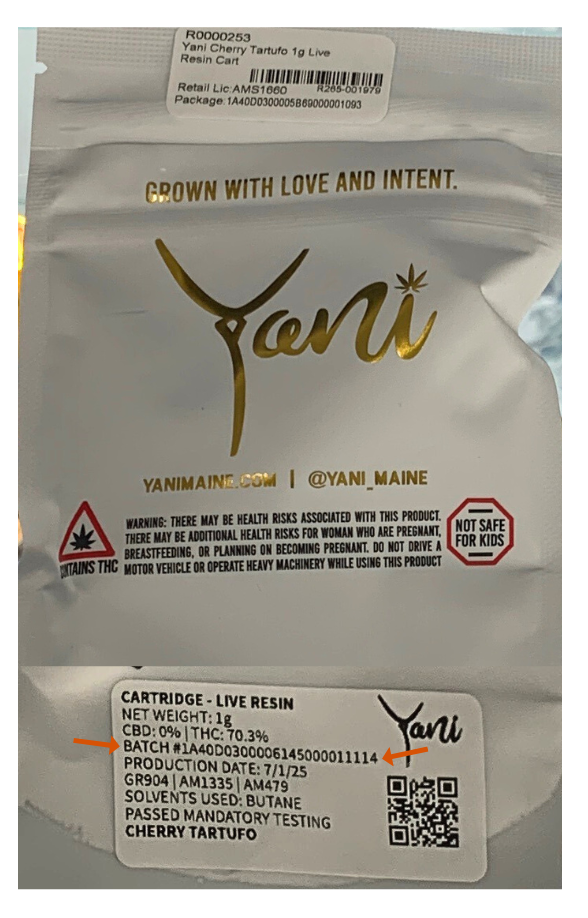
Around the same time, Maine issued a recall for certain Yani vape cartridges after
detecting a pesticide that is banned for use on cannabis intended for inhalation.
The recalled package stated that it was “grown with love and intent”
and had “passed all mandatory testing.”
Recalled Yani vape packaging: comforting claims on the front, serious pesticide issues in the recall notice.
That recall is separate from StickerGate, but it lives in the same ecosystem: packaging
and labeling that can look reassuring on its face while hiding important details about
what regulators eventually find. Together they raise a basic question for consumers:
how much weight should they place on the words and stickers on the bag?
And honestly, the strain name didn’t help.
“Slingria” is such a catastrophically bad name that it feels mislabeled even when it’s printed correctly.
Your brain reads it and immediately goes, “Nope, that’s not real. Somebody slipped.”
It doesn’t sound like cannabis — it sounds like the mystery liquid mopped off a nightclub floor at closing time.
It’s the kind of name that lowers consumer confidence just by existing, like the label is warning you:
If this is what they named it, imagine what they did behind the scenes.
The Slingria Ounce: Sold as Flower, Labeled as Shake
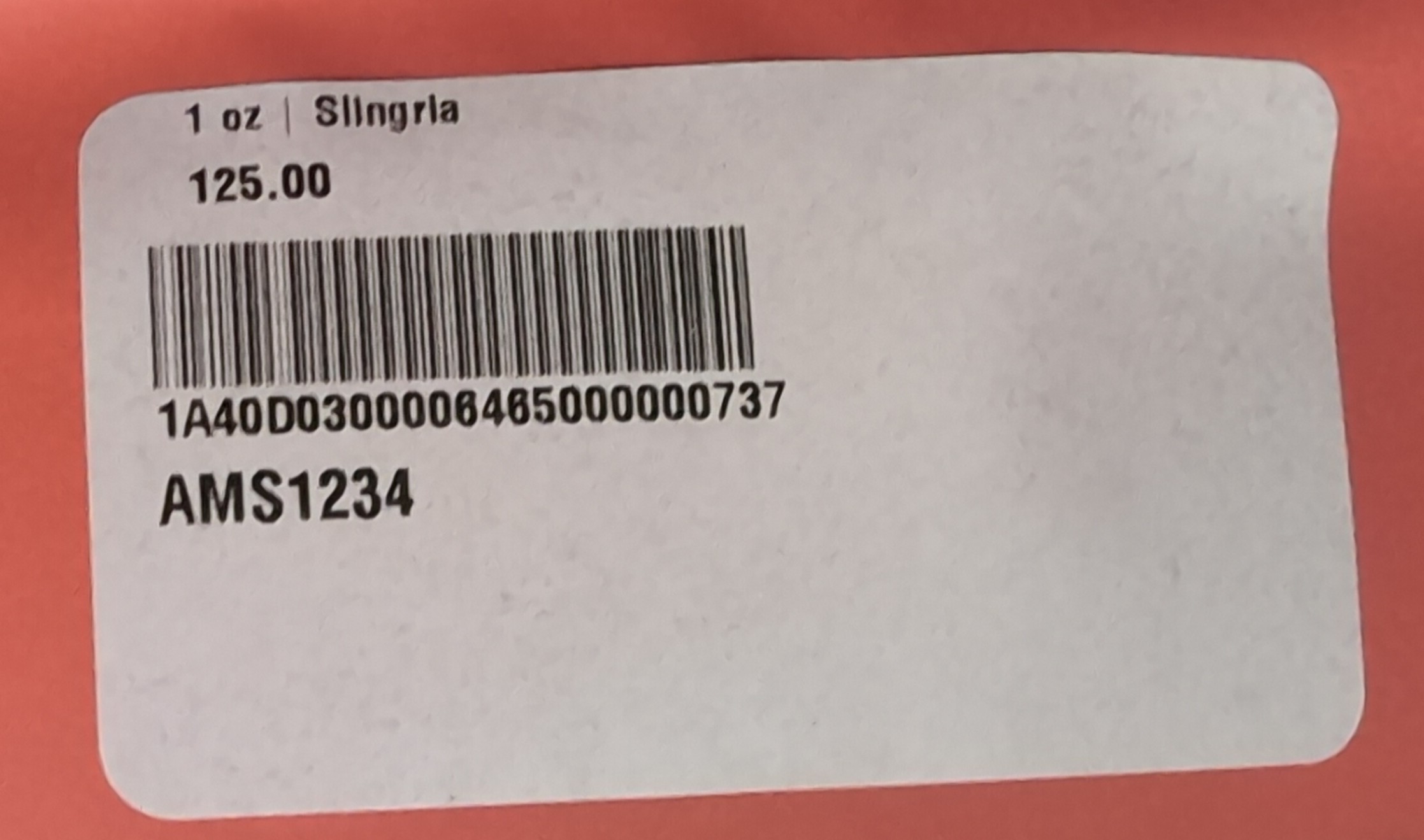
On the store’s menu, the product appears as “Find. – 1 oz | Slingria” in the
Flower → Whole-Flower category for $125. The promotional image shows
a pink Find. ounce bag with a large inline “1oz” mark consistent with whole flower branding.
Label as shown during preorder.
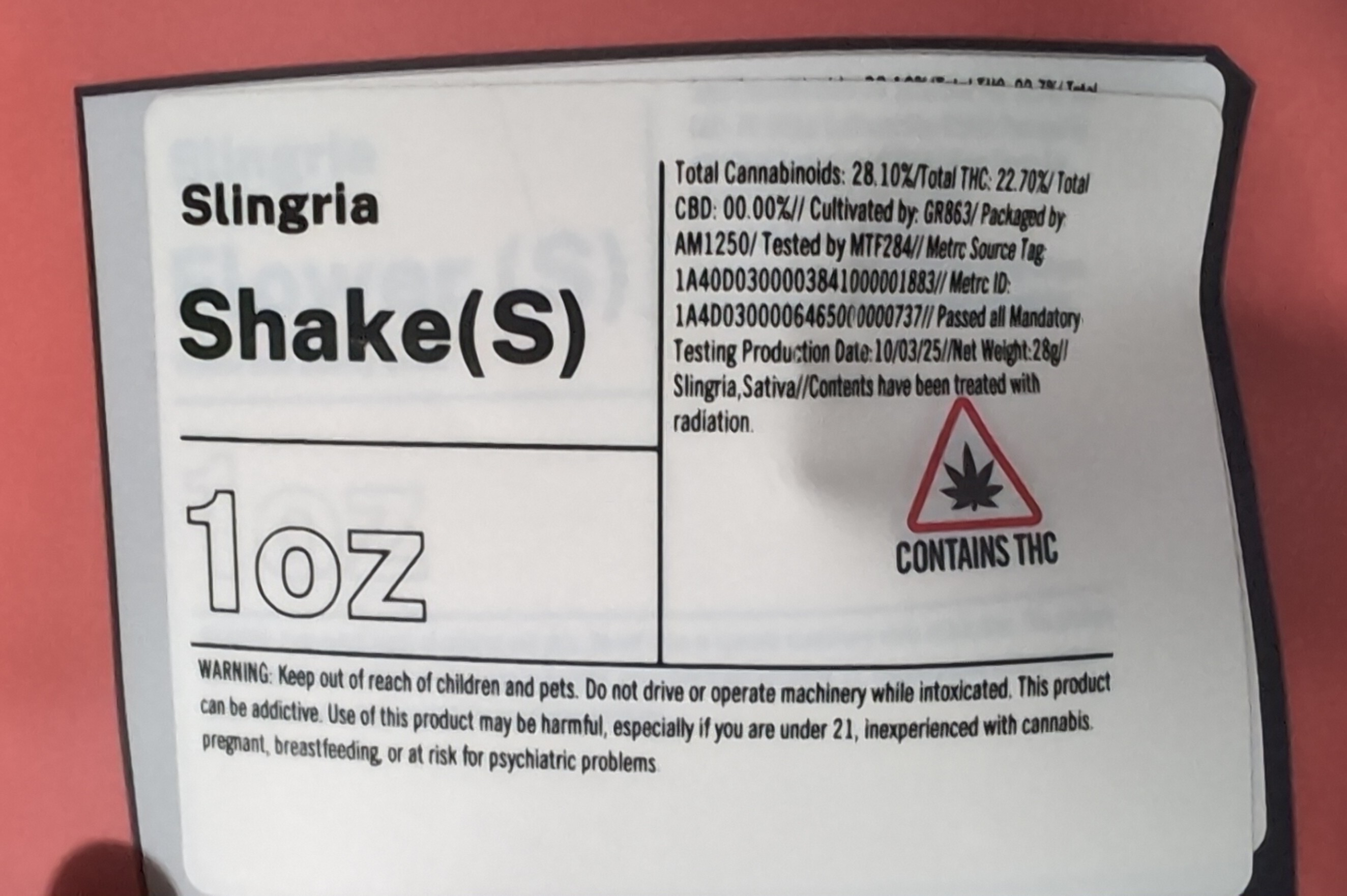
However, upon returning home and checking the product, the label affixed to the package read:
“Shake – Find Slingria.” The buds were small and inconsistent with typical whole-flower ounces.
I immediately called the store. I was told:
“Shake comes in a different color black bag — this is whole flower.”
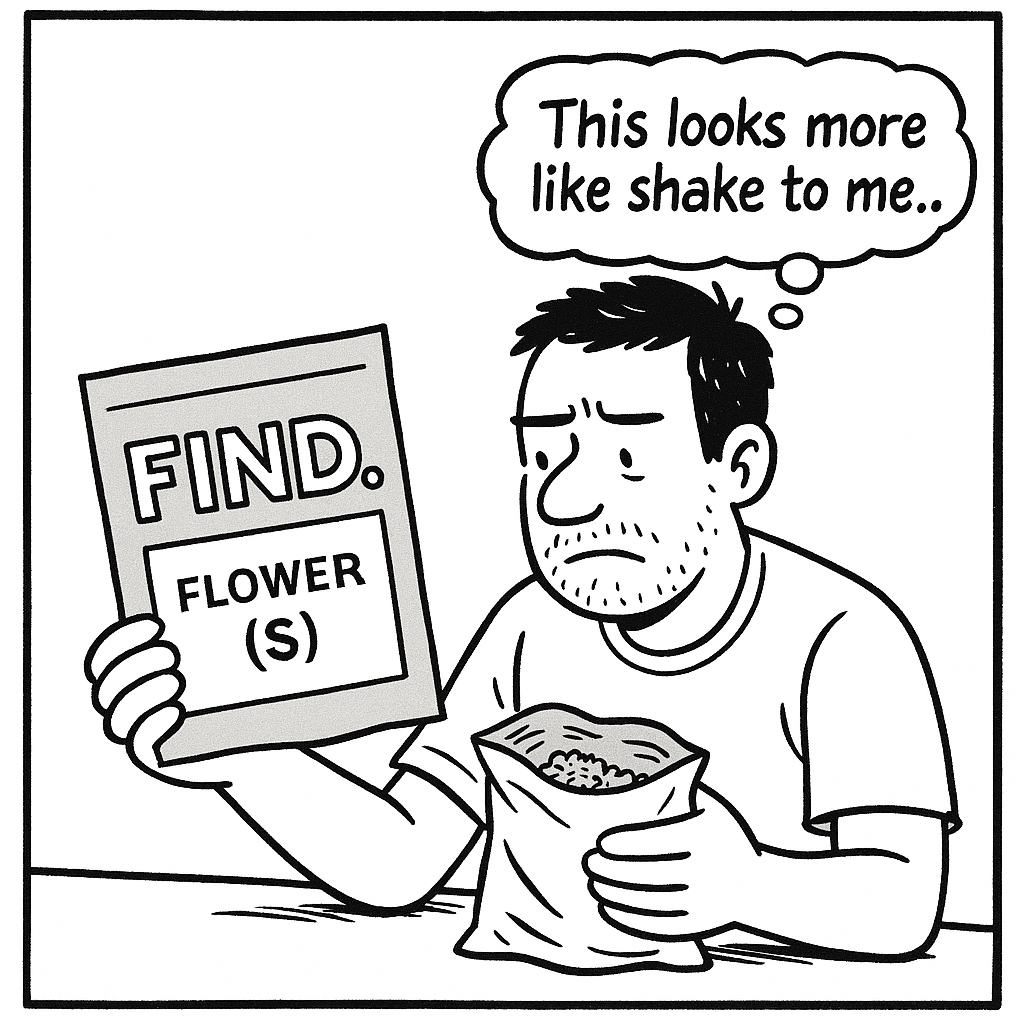
A parody of the Find. branding — fitting, because in this case the consumer really did
find a lot: stacked stickers, mismatched labels, and a whole series of questions about how a large
MSO manages its compliance.
I did not open the product. It remained sealed for a week until I could revisit the store. When I returned,
I asked to compare it with another ounce from the same batch. This second ounce:
had a flower label, not a shake label,
had noticeably larger buds,
had the same METRC package ID printed on the store price/SKU sticker.
The store uses the METRC package ID as the SKU for pricing and inventory.
I asked if the mislabeled ounce could simply be swapped with the clearly labeled whole-flower one. The budtender
brought my package to the back room. When it came back, the top sticker had been peeled off. Underneath was:
“The same batch, same grower — but labeled as Flower instead of Shake.”
I asked to keep the peeled sticker and reattached it to the bag at home. The underlying label remained intact,
confirming that stickers can be removed and replaced without damaging the base label.
Adult-Use Labels Placed on Top of Medical Labels
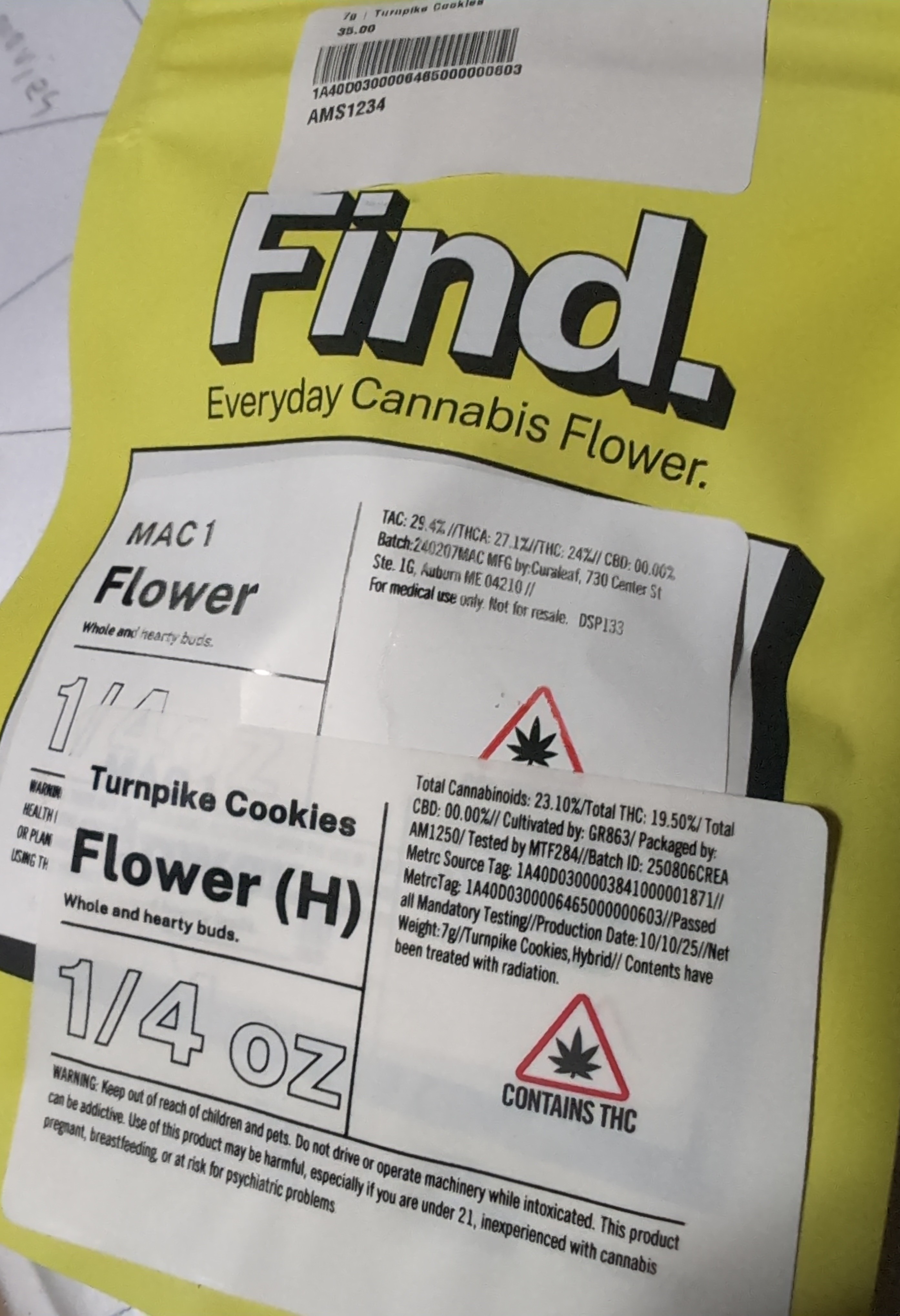
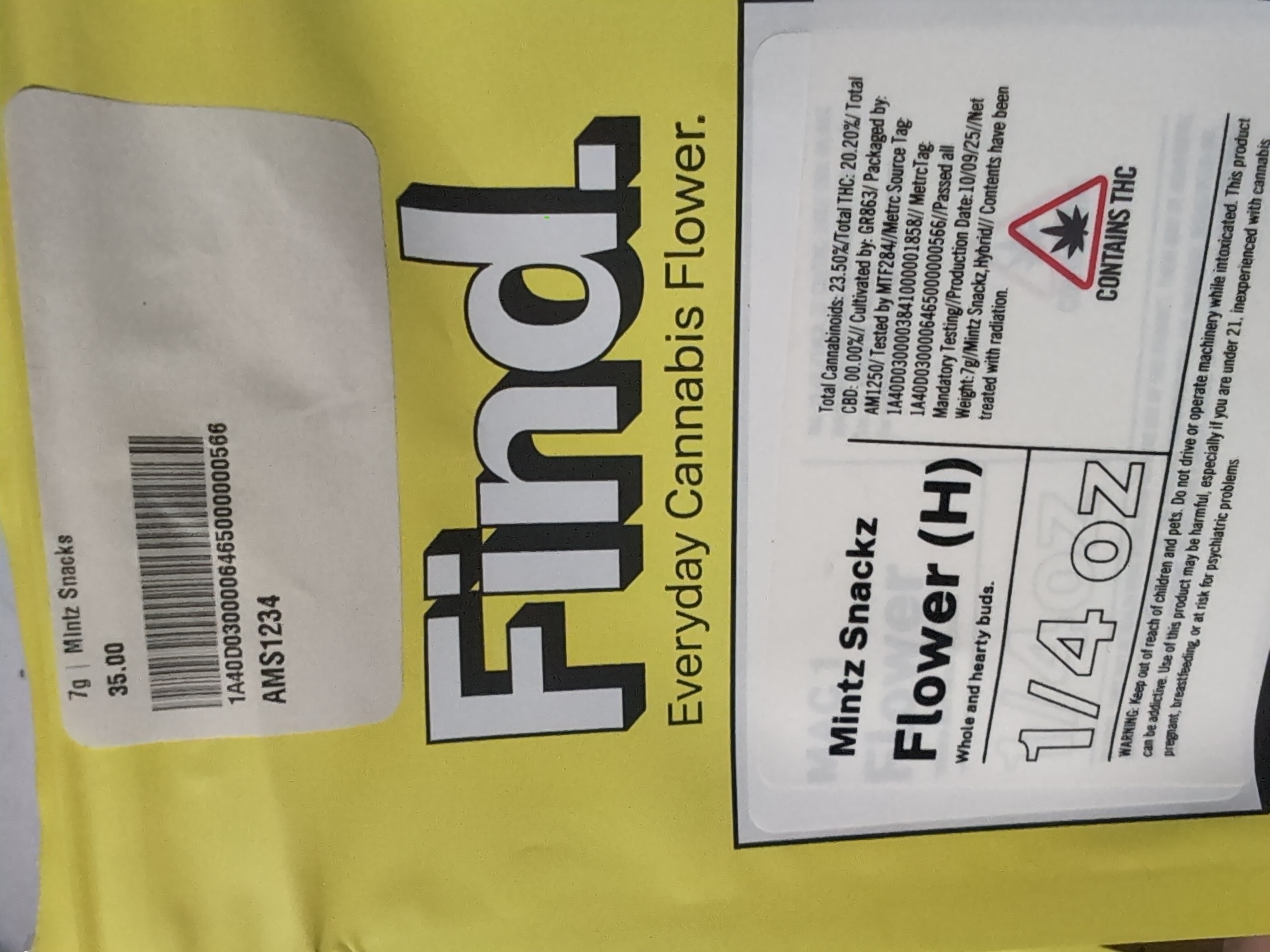
As part of a separate order placed on 11/12/2025 (Order #601501334),
two sealed 7-gram packages were purchased. Both packages had an adult-use sticker
placed on top of a medical label. One package was emptied and retained; the second
remains fully sealed.
In store, peeling the adult-use sticker off did not damage the medical label underneath.
These labels contain:
batch number,
category designation (medical vs. adult-use),
grower/manufacturer name,
and, in the medical labels’ case, no METRC package ID (as required).
One of the 7g medical labels with AU label applied over it.The second 7g package with the AU label still covering the medical label.
METRC, Package IDs & Tracking Limitations
From reviewing past purchase history, I initially assumed Maine required each
individual package to have its own METRC package ID on the consumer label.
However, this is not required under Maine’s rules. Only the
batch must be represented on the label — not the unique package.
This means:
the system is not tracking package-level details,
stores can (and do) reuse the package ID as their SKU,
package-level errors, swaps, and mislabeling are not detectable within METRC.
When asked whether we could check the category in METRC (to confirm whether my ounce was shake or flower),
I was told:
“We can’t see that.”
This reveals a gap between the appearance of a seed-to-sale tracking system and the reality of how it operates
for consumers.
Questions for the Office of Cannabis Policy (OCP)
These events raise several questions I will be submitting to the OCP:
Can a batch legitimately appear under two different categories (Shake and Flower) without a new process step?
If the source remains identical, what triggers a category change?
Is it permissible to place an adult-use sticker on top of a medical label for a different market?
Does this violate packaging rules or create traceability issues?
Is there any consumer-accessible way to verify METRC batch test results?
If not, why not? And would OCP support optional producer-added QR-code COA links?
Should stores be required to list product categories exactly as submitted to METRC?
If the system distinguishes shake from flower, consumers should know which they are purchasing.
Is it acceptable for a retailer to refuse to replace a mislabeled product when no tracking mechanism would detect the correction?
If not, what remedy exists?
Does OCP consider medical-label-under-AU-label packaging a compliance issue?
What information can OCP share with me regarding the following METRC package IDs?
– 1A40603000007F2000003823 (Slingria oz)
– [MEDICAL TAG #1]
– [MEDICAL TAG #2]
Conclusion
This situation does not prove anyone intentionally misled consumers. But the combination of:
mislabeled ounces,
adult-use stickers over medical labels,
no package-level tracking in METRC,
identical SKUs for multiple units,
and the recent Yani pesticide recall,
all point to a system that looks tightly regulated on paper but is, in practice, held together by…
well… smoke and stickers.